← Back to Insights

HOA Financial Fraud Prevention
The Internal Controls Every Board Needs

Embezzlement rarely starts with a criminal mastermind. It starts with one signature, one account, and nobody else looking. Here's how to close that gap.

Every HOA board eventually has this conversation, usually in a hushed tone after a meeting has officially ended: "Have you ever actually looked at the bank statements, or do we just trust that the numbers in the report match?" More often than anyone would like to admit, the honest answer is that nobody has checked. The treasurer says the numbers are right, the board believes the treasurer, and the assumption gets passed down year after year, board term after board term, until it simply becomes how things are done.

That assumption is exactly the gap that HOA fraud slips through. It's a pattern that shows up in local news stories with depressing regularity: a well-liked, long-serving treasurer, trusted implicitly by neighbors who considered them a friend, quietly moves association funds into a personal account over months or years. Nobody suspected anything because nobody was structurally required to look. The fraud isn't usually discovered by an alert board member catching a discrepancy — it's discovered when that treasurer finally steps down and someone new opens the books for the first time.

This isn't a story about bad people. Most HOA treasurers are honest, and the overwhelming majority of community associations never experience fraud. But HOAs share a structural vulnerability that makes them unusually easy targets when something does go wrong: a single volunteer, often unpaid and rarely trained in accounting, frequently holds sole control over both the checkbook and the books that describe what the checkbook did. There's no separate finance department. No compliance officer. No second set of eyes required by policy. Trust becomes the entire control system — and trust, on its own, isn't a control at all.

The good news is that the fix isn't complicated, expensive, or a reflection on anyone's integrity. It's a small number of structural habits that, once in place, make fraud dramatically harder to commit and dramatically easier to catch early if it happens anyway. Here's what those habits look like.

Why HOAs Are an Easy Target

Picture the typical financial workflow in a self-managed HOA. The treasurer receives assessment payments, deposits them, pays the vendors, reconciles the bank account, and prepares the report the board sees at the meeting. One person touches every step. There is no moment in that chain where a second, independent set of eyes is structurally required to see what happened before the money has already moved.

Compare that to how a business — even a small one — typically handles money. The person who approves an expense usually isn't the same person who cuts the check, and neither of them is usually the person who reconciles the bank statement at month's end. That separation exists specifically because it makes fraud require collusion between multiple people rather than the judgment lapse of one. HOAs, run by volunteers with limited time and no formal training, tend to collapse all of those roles into whoever raised their hand to be treasurer.

Add to that the informality of most treasurer handoffs. When a volunteer treasurer's term ends, the transition is often a folder of documents and a login password, not a reconciled audit trail reviewed by an outgoing and incoming officer together. Years of financial history can pass from person to person without anyone outside that role ever independently verifying that the numbers on the report matched the numbers in the bank.

The uncomfortable truth: in most HOA fraud cases that eventually make the news, the controls that would have caught it early weren't complicated. They just didn't exist. A single reconciliation review by someone other than the treasurer would very likely have surfaced the problem within months instead of years.

Segregation of Duties: The One Control That Matters Most

If a board can only adopt one control this year, this is the one. Segregation of duties means no single person handles a financial transaction from start to finish without at least one other set of eyes involved somewhere in the process. It doesn't require hiring anyone or spending money — it requires distributing existing responsibilities across more than one board member.

In practice, this looks like: the treasurer prepares payments, but a second board member (often the president or vice president) reviews and co-signs checks or approves electronic payments above a set threshold. The person who deposits incoming assessment payments isn't the only person who ever sees the bank statement — someone else on the board reviews it independently each month, not just the treasurer's summary of it. Vendor additions and changes to banking information require sign-off from more than one person, since redirecting a legitimate vendor payment to a fraudulent account is one of the more common fraud patterns in any small organization.

None of this implies distrust of the treasurer. It's the same logic behind why pilots use pre-flight checklists even after thousands of hours of experience, and why publicly traded companies require independent auditors even when their own accounting staff is excellent. Good controls protect honest people as much as they deter dishonest ones — an honest treasurer who is the sole financial gatekeeper is also the person who gets unfairly blamed for any discrepancy nobody else was positioned to catch earlier.

A simple starting rule: no payment above a set dollar threshold — many communities use $500 to $1,000 — should go out without a second board member's review and approval, and no one person should be able to both initiate a payment and reconcile the account it came from.
The Documentation Habit Most Boards Skip

Segregation of duties prevents fraud. Documentation catches it early if prevention fails. Most HOAs already generate more useful documentation than they realize — the problem is that nobody is required to actually look at it on a regular schedule.

A monthly bank reconciliation, reviewed by someone other than the person who prepared it, is the single most powerful early-detection tool available to a volunteer board. This doesn't need to be a forensic audit. It's a straightforward comparison: does the ending balance on the bank statement match the ending balance in the association's books? Do all the transactions in one appear in the other? Is anything unfamiliar — a vendor nobody recognizes, a check number out of sequence, a transfer nobody remembers approving? This kind of review takes a board member 20 to 30 minutes a month and is the reason most fraud, when it does occur, gets caught within a matter of months rather than years in communities that actually do it.

Beyond monthly reconciliation, a complete audit trail matters more than most boards appreciate until they need one. Every transaction should have a timestamp, a record of who initiated it, and — for payments — a record of who approved it. This isn't about creating paperwork for its own sake. It's about making sure that if a question ever comes up, whether from a suspicious homeowner, an incoming board, or an actual investigation, the answer already exists in a form nobody has to reconstruct from memory.

"We didn't think we needed an audit trail because we trusted our treasurer completely. We were right to trust her — but when a homeowner asked a pointed question at an annual meeting, having the timestamped record meant we could answer in the room instead of promising to 'look into it' and hoping the question didn't come up again."

What good documentation buys a board: not just fraud detection, but the ability to answer any homeowner's question about where the money went — instantly, with a record, rather than a reassurance that requires trust nobody outside the treasurer's role can independently verify.

What Oversight Actually Looks Like at the Board Table

Controls only work if someone is actually exercising them, which means the board as a whole — not just the treasurer — has to build financial oversight into its regular rhythm. This doesn't require every board member to become an accountant. It requires a handful of habits that turn oversight from an abstract responsibility into something that actually happens every month.

Every board meeting should include a genuine review of the financials, not a rubber-stamp acceptance of a report nobody reads closely. At least one board member other than the treasurer should be reviewing the bank statement independently each month, as described above. Many well-run associations also bring in an independent CPA to perform a review or compilation annually — not a full audit, which can be costly for smaller communities, but a level of outside scrutiny appropriate to the association's size. And treasurer transitions should include a formal handoff meeting where outgoing and incoming officers, ideally alongside a third board member, walk through the current reconciliation together before anyone signs off that everything is in order.

It's also worth having an honest conversation, once a year, about what would happen if something did go wrong. Does the association carry fidelity bond or crime insurance covering employee or volunteer theft? Many HOA insurance policies include this coverage by default, but plenty of boards have never confirmed it, and some governing documents or state statutes actually require a minimum coverage amount that nobody has checked in years.

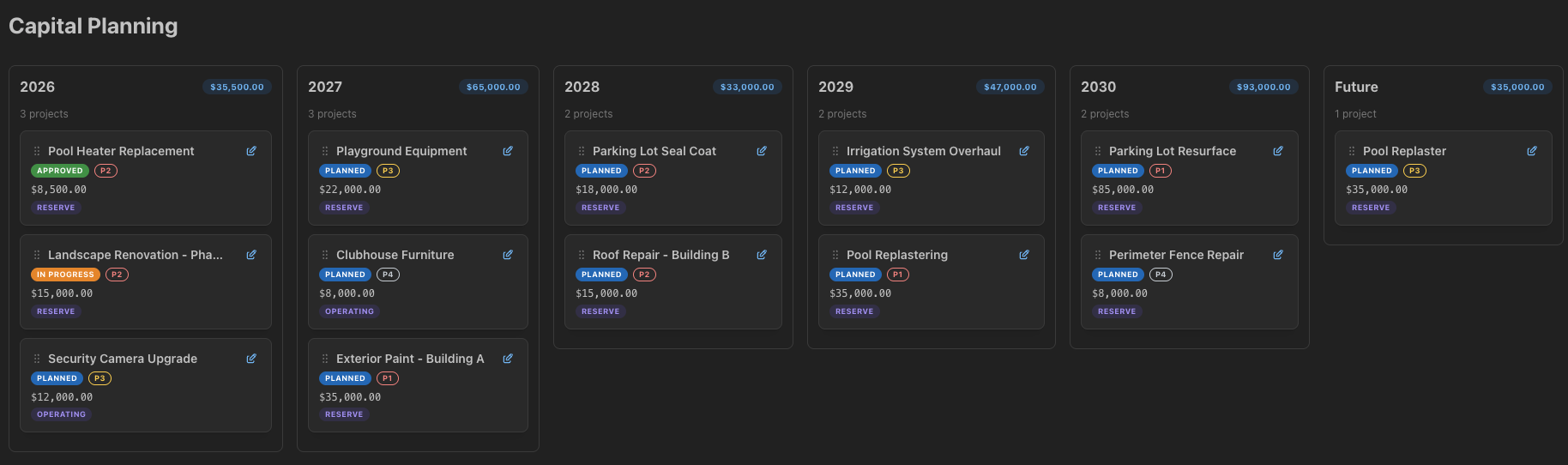
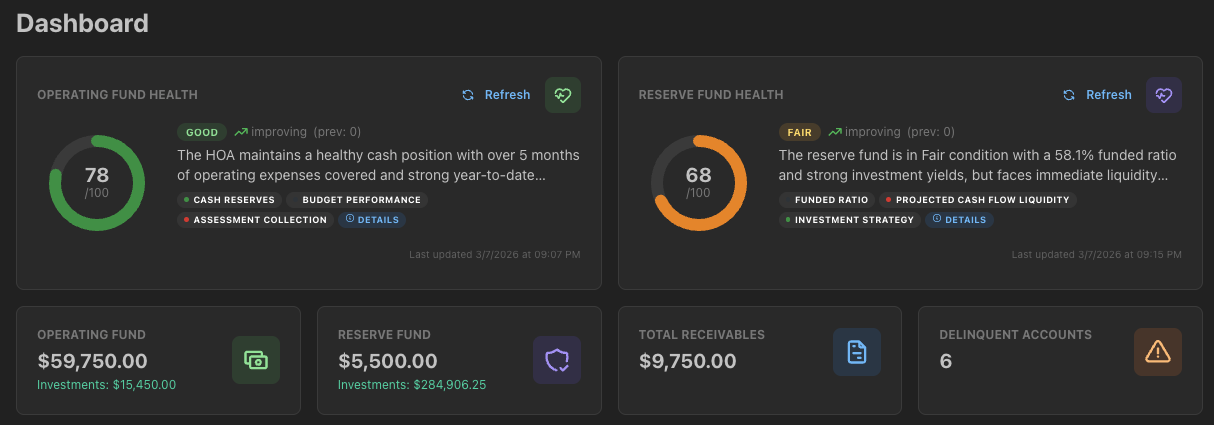
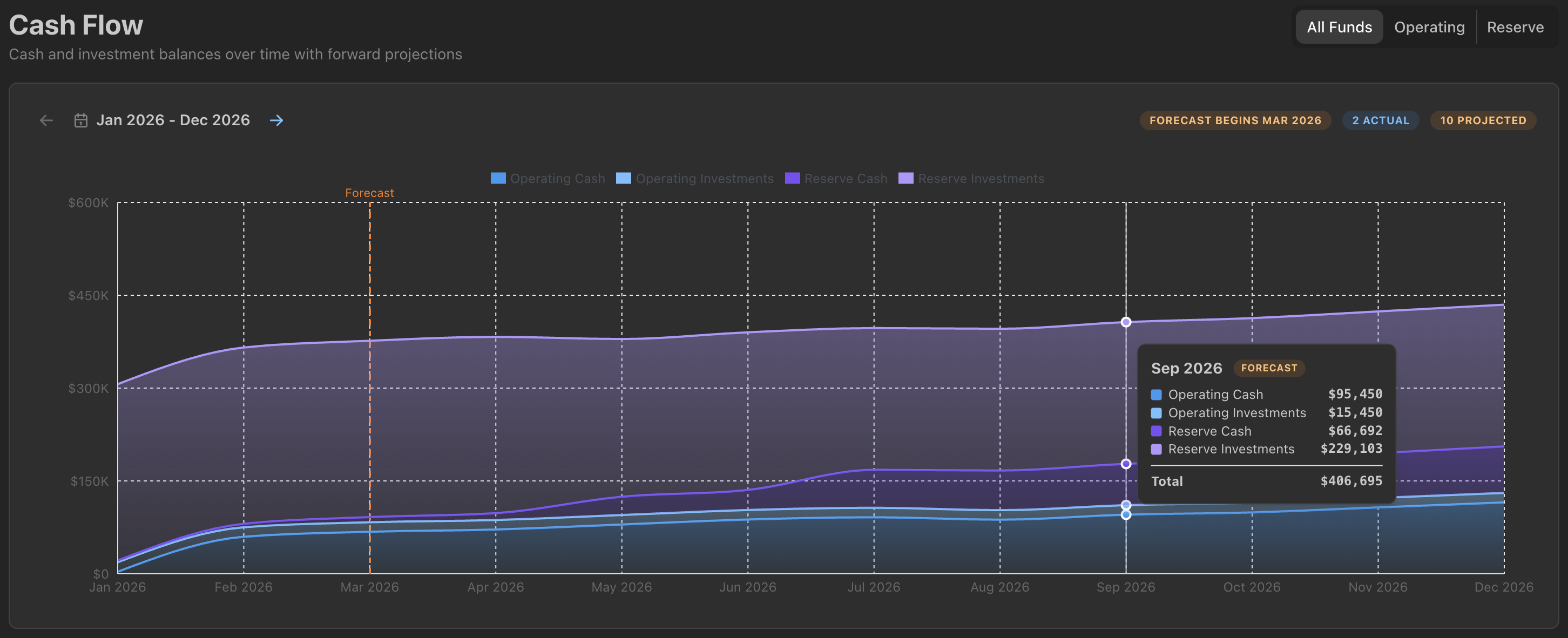
What technology changes: a platform that logs every transaction automatically, flags unusual activity, and gives every board member — not just the treasurer — real-time visibility into the books removes the dependency on any one person's memory or goodwill. HOA LedgerIQ's audit trail keeps a timestamped record of every entry and every approval, so oversight doesn't depend on someone remembering to ask the right question.

Financial Oversight That Doesn't Depend on Memory

A complete, timestamped audit trail and real-time dashboards give every board member visibility — not just the person holding the checkbook.

What This Looks Like in Practice

Consider a 90-unit community that decides, after a scare at a neighboring HOA made the local news, to formalize its financial controls. The board doesn't hire anyone new or spend a dollar on the change. It simply agrees on a handful of new habits.

The treasurer still handles the day-to-day bookkeeping and initiates payments, but the vice president now reviews and co-approves anything over $750 before it goes out, and reviews the bank statement independently each month rather than only reading the treasurer's summary at the meeting. Vendor banking changes now require a two-person sign-off after the board realizes, during the conversation, that they'd never actually verified how a wire redirect request would be caught if one ever came in by email — a scam that has hit other HOAs and small nonprofits with alarming frequency.

Six months in, the independent bank review catches a bookkeeping error — not fraud, just a misapplied vendor payment — within three weeks of it happening, instead of at year-end reconciliation the way it would have gone unnoticed before. The board fixes it in an afternoon. At the annual meeting, when a homeowner asks pointedly where a specific special assessment payment went, the treasurer pulls up the timestamped record in seconds instead of promising to follow up later. Nobody at that meeting realizes how much smoother that exchange was than it would have been a year earlier — which is exactly the point. Good controls are supposed to be invisible when nothing has gone wrong, and instantly available the moment something needs to be checked.

Trust, But Build the System Anyway

No board wants to treat its treasurer like a suspect, and building internal controls doesn't require that mindset. The entire point of segregation of duties, monthly reconciliation review, and a real audit trail is that they protect everyone involved — the community's money, certainly, but also the volunteer who would otherwise carry the full, unverifiable weight of "just trust me" for as long as they hold the role.

The communities that get burned by HOA fraud are rarely the ones with suspicious treasurers. They're the ones that never got around to building a system that didn't depend entirely on trust in the first place. That's a fixable gap, and closing it costs a board nothing but the discipline to make oversight a habit rather than an assumption.

Give Every Board Member Real Visibility.

HOA LedgerIQ's automatic audit trail and real-time dashboards mean financial oversight never has to rely on one person's memory.

Start Your Free 14-Day Trial

No credit card required  ·  14-day free trial  ·  No contracts

← Previous: How to Read Your HOA's Reserve Fund Health Score All Insights →